10 September 2026
In this article, I will summarize the best FDA-approved premium Intra-Ocular Lens (IOL) implants for cataract surgery as of September 2026.
I am writing as a cataract surgeon with over 26 years of experience, tens of thousands of cataract surgeries under my belt, and whose current Manhattan private practice focuses almost exclusively on premium cataract surgery. My assessment comes from the most reliable of sources – my patients and their direct feedback and outcomes. Our practice philosophy is simply to cultivate and deliver world-class cataract surgery experience and outcomes, and that entails evaluating and implanting virtually all FDA-approved IOLs. Every few years, new models of IOLs are released, and as we gain experience, certain models rise above the rest.
Some definitions and simple vocabulary your eye surgeon may use
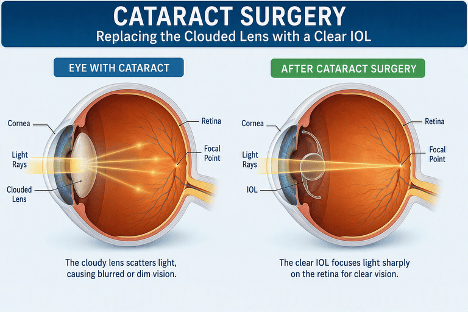
- A cataract is the clouding of the natural human lens that causes blurry vision.
- Cataract surgery is the removal of the cloudy lens and the placement of a man-made Intra-Ocular Lens (IOL) implant that lasts a lifetime.
For discussing IOLs, we need to establish the three zones of vision:
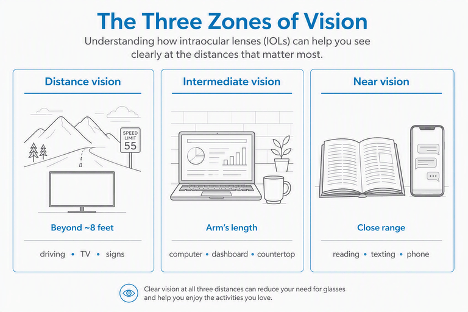
- Distance vision refers to vision beyond 8 feet, such as seeing the subtitles on TV, driving, signs & theater
- Intermediate vision (or midrange vision) is the desktop computer, the dashboard/GPS of a car, and the countertop.
- Near vision is for reading, texting, and using our smartphones.
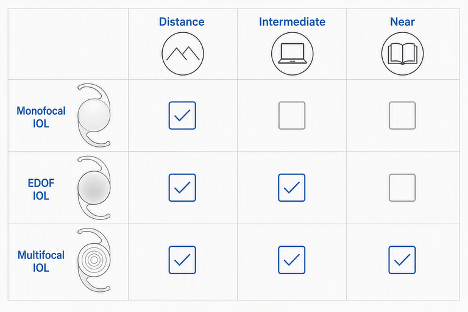
IOLs come in three broad categories:
- Monofocal IOLs – They focus vision to on one of the three zones and glasses are needed for the other two
- Multifocal IOLs (or Full Range of Vision IOLs) – They focus vision on all three of the zones
- Extended Depth of Focus (EDOF) IOLs – They focus vision on two of the three zones – typically distance and intermediate
First and foremost, there is no perfect IOL. There are pros and cons to all IOLs
The Monofocal IOL
The Monofocal IOL can provide good glasses-free vision at one of the three zones of vision. Most patients electing a monofocal IOL choose distance vision, and then still require (readers or progressive) glasses for seeing intermediate and near tasks. About 15% of my monofocal IOL patients (previously near-sighted or myopic patients) chose a near target in both eyes. This allows them to read a book or use their phone glasses-free, but they need full-time distance glasses and even computer glasses. And then about 20% of patients chose one eye for distance and the other eye for intermediate or near vision (or somewhere in between – since we only have two eyes for three zones). This strategy is known as monovision. I usually reserve this for patients who have utilized this with contact lenses or have natural monovision, and we know their visual system (i.e., brain) can handle the discrepancy.
My top monofocal IOL is the Johnson and Johnson Tecnis monofocal IOL
It has withstood the test of time and is the monofocal IOL most requested by other ophthalmologists for their eyes due to its excellent visual quality. Again, as a monofocal, it will require full-time reading (or distance) glasses.
There is one specialty monofocal IOL called the Light Adjustable Lens. It’s the only IOL in the world that we adjust and fine-tune in the eye, a few weeks after the surgery, to get a more precise focus. While the LAL can be used in most eyes, I use the LAL in three situations: post-LASIK (or other corneal refractive surgery) patients, very near-sighted patients (high myopes), and patients choosing monovision.
Post-LASIK patients and nearsighted patients have a lower targeting accuracy with standard IOL formulas, and the LAL allows more precision by allowing us surgeons to adjust any leftover glasses prescription after cataract surgery using light rays in the office (by subtly changing the LAL’s shape in the eye). Monovision patients also benefit from better targeting of their distance eye, and allowing us to adjust the near focus zone to their liking and lifestyle.
The Multifocal IOL (Also referred to as a Full Range of Vision IOL)
The Multifocal IOL (Also referred to a Full Range of Vision IOL) can provide good glasses-free vision at all three distances – distance, intermediate and near. The pros are that this IOL is most likely to provide complete spectacle independence. The cons are that the IOLs achieve this by splitting light, and patients may notice nighttime visual artifacts such as glare and halos around lights (such as headlights and streetlamps). Also, there is a loss of light energy from the splitting, which manifests as some mild loss of contrast compared to a monofocal lens. Healthy eyes will not notice any visual difference; however, imperfect eyes can be impacted by this mild contrast loss and end up with poor quality of vision. So multifocal IOLs are mostly reserved for healthy eyes without concurrent disease, and that have 20/20 potential.
Our current multifocal IOLs are what I consider the 7th generation. I’ve implanted the most popular three, including the J&J Odyssey, B&L Envy, and the Alcon PanOptix Pro. They all have their slight nuances between each other.
I find the B&L Envy is the best all-around multifocal IOL and is my go-to multifocal. The Envy has the fewest nighttime complaints of the three and excellent near vision. The Odyssey IOL is great in a post-LASIK eye as it has a feature called tolerance to refractive error (TRE), which means people still can see 20/20, even with some residual myopia or astigmatism – a common finding especially in post-LASIK eyes.
The Extended Depth of Focus (EDOF) IOL
The Extended Depth of Focus (EDOF) IOL can provide two of the three zones of vision. That is typically excellent distance and intermediate vision. Light readers (about a +1.25D) are still required for reading small print or small phone font. We are now in the third generation of EDOF IOLs in the US. Released in the spring of 2026, the Johnson & Johnson Vision PureSee IOL is the best EDOF IOL -- and it has become one of our most popular IOLs. Most patients are spectacle-free and enjoy excellent night vision. Furthermore, this IOL preserves contrast, which means it can be used in imperfect eyes, just like a monofocal lens could. This IOL is chosen for patients who want the widest range of vision with the best nighttime quality of vision, and understand that reading glasses for fine print will still be needed. Sometimes, I offset one of the eyes slightly, targeting some near – micro monovision, and patients can even gain more spectacle independence.
In summary, the best premium IOLs in 2026
- EDOF: J&J PureSee IOL
- Multifocal: B&L Envy
- Specialty Monofocal: RxSight Light Adjustable Lens (LAL)